
Poetry as Prayer
notice, wonder, listen, lament, and praise
Explore poetry as a creative form of prayer. Discover how images, attention, honesty, and silence can draw us into a deeper presence with God.
Prayer and poetry begin in the same place: attention. Both invite us to notice what stirs beneath the surface—to give voice to grief and gratitude, longing and love, doubt and wonder. Poetry and prayer also make room for silence, mystery, and awe when words are not enough.
Let the words of my mouth and the meditation of my heart be acceptable to you, O Lord, my rock and my redeemer. (Psalm 19:14)
HONEST WRESTLING
The Psalms are full of the beautiful contradictions of being human: praise and anger, gratitude and abandonment, confidence and fear, love and doubt. Nothing needs to be tidied up before it becomes prayer. We are invited to come as we are.
Sometimes an image can convey what an explanation cannot—such as these evocative lines by the Victorian poet Christina Rossetti:
My life is like a frozen thing,
No bud nor greenness can I see:
Yet rise it shall—the sap of Spring;
O Jesus, rise in me.
Perhaps your soul has known this frozen ground—a season when nothing seems to grow. Rossetti’s poem invites us to imagine that even beneath what appears lifeless, something may be waiting. The sap may rise again. Spring may come.
WHAT WORDS DO NOT SAY
Sometimes our experiences are simply too large, too painful, too beautiful, or too mysterious for words. Scripture speaks of “groanings too deep for words.” Poetry and prayer both leave room for what cannot be said.
Rebbe Nachman poured out his heart before God as he wandered alone among trees, grasses, and growing things. As he prayed, the living world around him became part of the prayer. Trees and grasses, solitude and stillness—all drew him into conversation with the one to whom he belonged.
Perhaps we do not always need to make prayer happen. Perhaps we simply need to be quiet long enough to notice the prayer already unfolding around us.
WHEN THE HEART IS STONE
In her poem “Good Friday,” Rossetti asks:
Am I a stone, and not a sheep,
That I can stand, O Christ, beneath Thy cross…
And yet not weep?
She does not write what she thinks she should feel. She simply notices what is true and offers her question to God, who can bring water from stone.
What if we did the same?
Prayer and poetry make room for our unanswered questions, our numbness, our exhaustion, our doubt, and our fragile faith. Even ”I don’t know what I feel” can be the beginning of prayer.
FINDING NEW LANGUAGE
Poetry reminds us that words can carry more than their definitions. Hebrew offers a beautiful example: the word Baruch means “to kneel” (berekh) and “to bless” (barak). Suddenly, blessing takes on movement and imagery: a body bending in humility and reverence, God’s blessings both given and received.
Poetry invites us to play with language in this way. Images, metaphors, rhythm, repetition, and sound can help us discover what we did not know how to say. Poetry need not explain our suffering or resolve our questions. Sometimes it simply shapes them. Sometimes it helps us notice a glimmer of beauty or a whisper of peace.
Try completing this sentence: My soul feels like…
- a seed beneath the soil.
- a river searching for the sea.
- a desert desperate for rain.
- frozen ground.
- a garden surprised by spring.
What image comes to you? Stay with it for a moment. See where it leads.
FROM INFORMATION TO TRANSFORMATION
Poetry as prayer is ancient. The Psalms are poetry, prayer, and song woven together. Athanasius described the Psalter as a mirror of the human soul.
Perhaps that is why we continue to return to the Psalms. They make room for the whole landscape of our lives: wonder and fury, grace and shame, loneliness and longing, lament and delight.
Poetry slows us down enough to notice that landscape.
- A word catches our attention.
- An image unlocks an experience.
- A rhythm changes what we hear.
Prayer invites us to bring what we notice into God’s presence. Not everything needs to be understood. Not everything needs to be resolved.
Sometimes transformation begins with presence—with God, with ourselves, with one another, and with the astonishing world around us.
AN INVITATION TO POETIC PRAYER
Begin where you are. Look around. Notice:
- the tree outside your window.
- the light spilling across the floor.
- your weary body.
- a grief you have been carrying.
- a memory that keeps returning.
- something beautiful you almost missed.
Choose one thing and linger there. Then begin with a few words:
- I notice…
- I am grateful for…
- How I long…
- O God, how…
- My soul feels like…
Follow the image wherever it leads. Let yourself be surprised. God simply invites us to come—honestly, willingly, and with a desire to notice, wonder, deepen, and grow.
This is where poetry and prayer meet.
We say what we can and make
room for what we cannot.
We notice. We wonder. We listen.
We lament. We praise. We ask.
And sometimes, when the words
have gone as far as they can,
we let silence become prayer.
FREE PRINTABLES
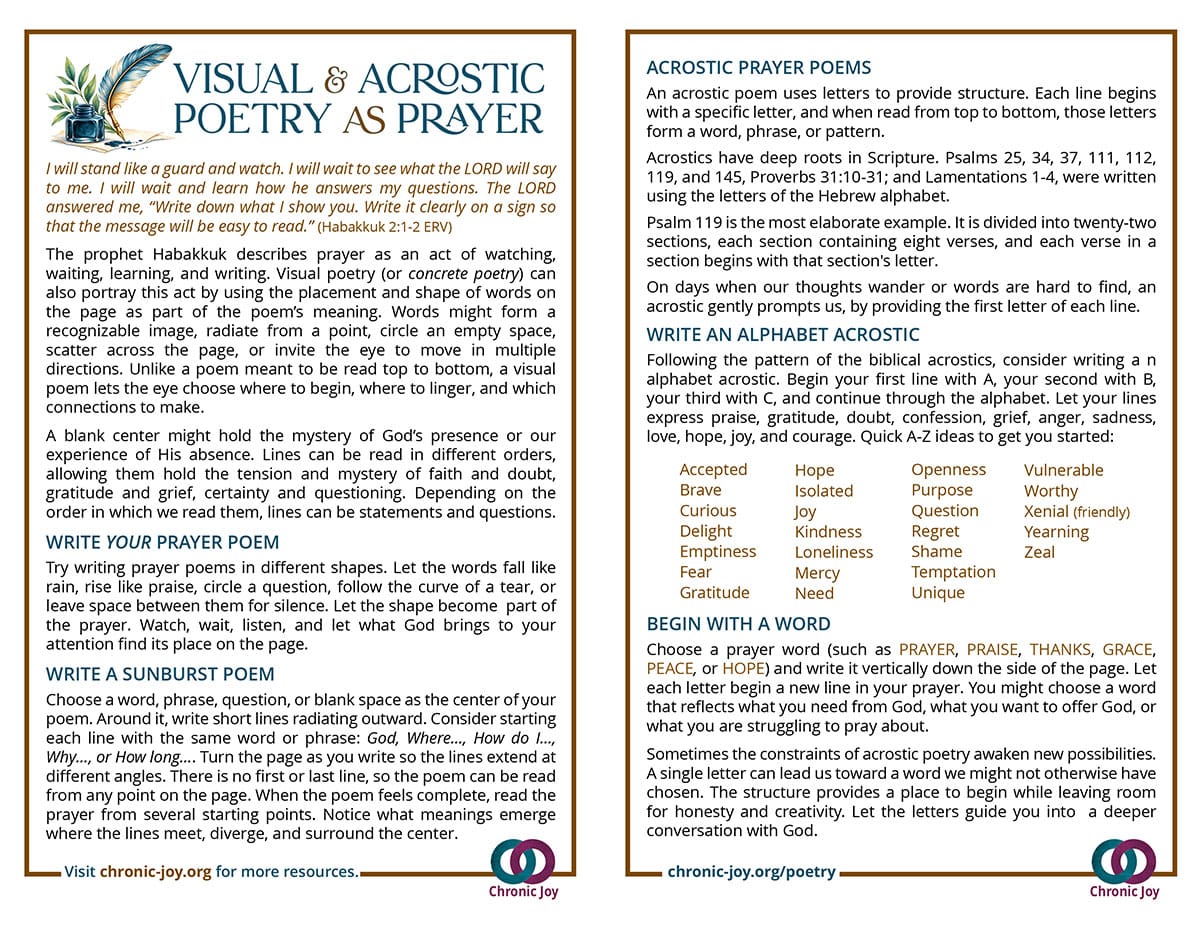
Visual & Acrostic Poetry As Prayer
Explore visual poetry and acrostic prayer as creative ways to meet with God. Shape words, questions, silence, and Scripture into prayers that make space for honest reflection, listening, hope, and wonder.
POETRY PROMPT
Wait • Not Yet, Not Now • Poetry Prompt
I sat silent in the newness of day, my Bible reading complete, journal open, asking the Lord what He wanted to share with me. I was feeling impatient with the pain that lingered in my back, also restless for face-to-face connection during this time of social distancing.
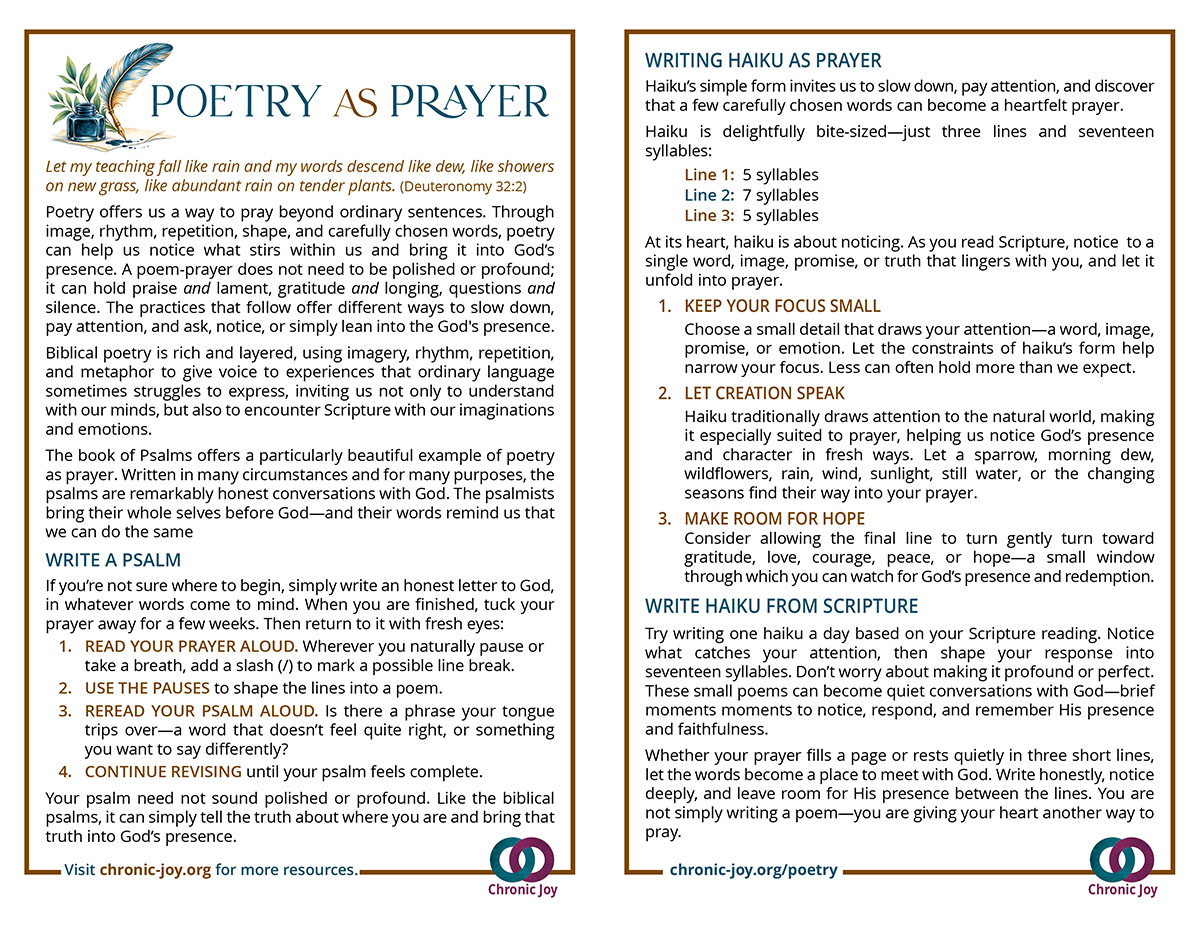
Poetry as Prayer
Discover poetry as prayer through psalms, haiku, Scripture, and simple writing practices that invite you to slow down, notice deeply, express your heart honestly, and meet God in the sacred space between words.
POSTS TO PONDER
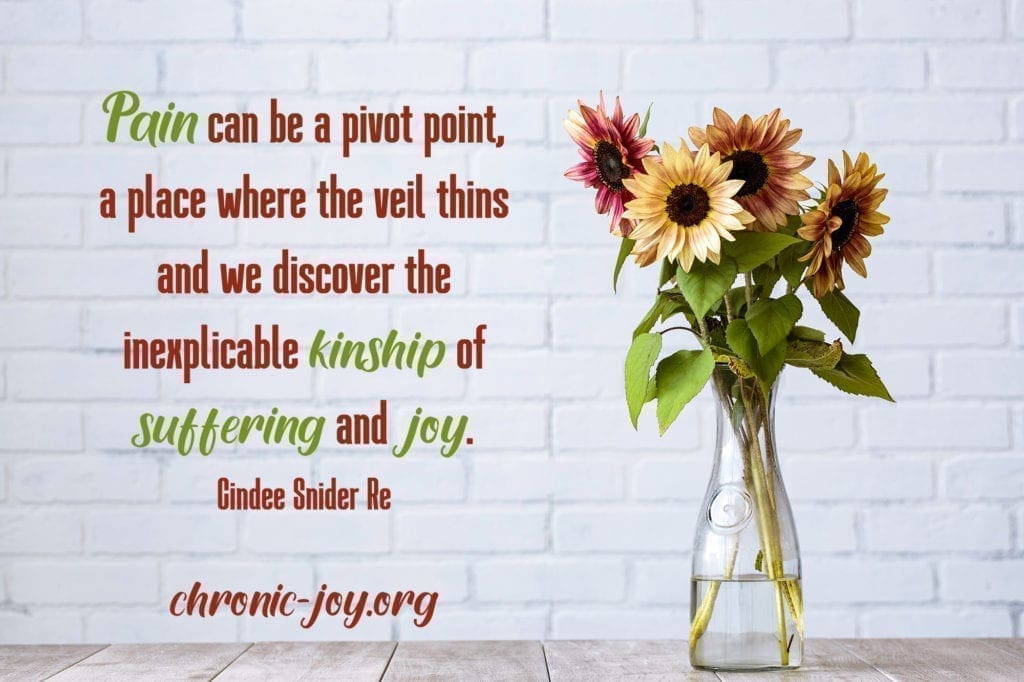
The Gift of Pain (A Poem)
Pain can be a pivot point, a place where the veil thins and we discover the inexplicable kinship of suffering and joy.

Mountain Breezes
Amy Carmichael
Mountain Breezes is an anthology of 565 poems by Amy Carmichael, gathered from her published books. The untitled poems have been given titles, and the editors have arranged the poems under seven major headings: worship, petition, surrender, ministry, wartime, encouragement, and youthful thoughts.


Devotions: The Selected Poems of Mary Oliver
Mary Oliver
Throughout her celebrated career, Mary Oliver has touched countless readers with her brilliantly crafted verse, expounding on her love for the physical world and the powerful bonds between all living things. Dwight Garner has identified her as “far and away, this country’s best-selling poet.” Now, she returns with a stunning and definitive collection of her writing from the last fifty years.

The Joy of Poetry: How to Keep, Save, & Make Your Life with Poems
Megan Willome
Part memoir, part humorous and poignant defense of poetry, this book illustrates what it is to live a life with poems at your side. Megan’s story is one you won’t want to put down. Meanwhile, her uncanny ability to reveal the whys and hows of poetry calls winsomely—to even the biggest poetry doubter. If you already enjoy poetry, Megan’s story, wisdom, and ways will invite you to go deeper through novel ideas on engaging poetry.

Book of Hours: In Shadow and Sun
Jamie Wright Bagley
For souls crying out for nourishment amid the pressures of daily living—this book is for you. For tired hearts feeling lost, scattered, restless, uninspired—this book is for you. For those who find their hours slipping past too quickly while longing to make their moments count—this book is for you.