
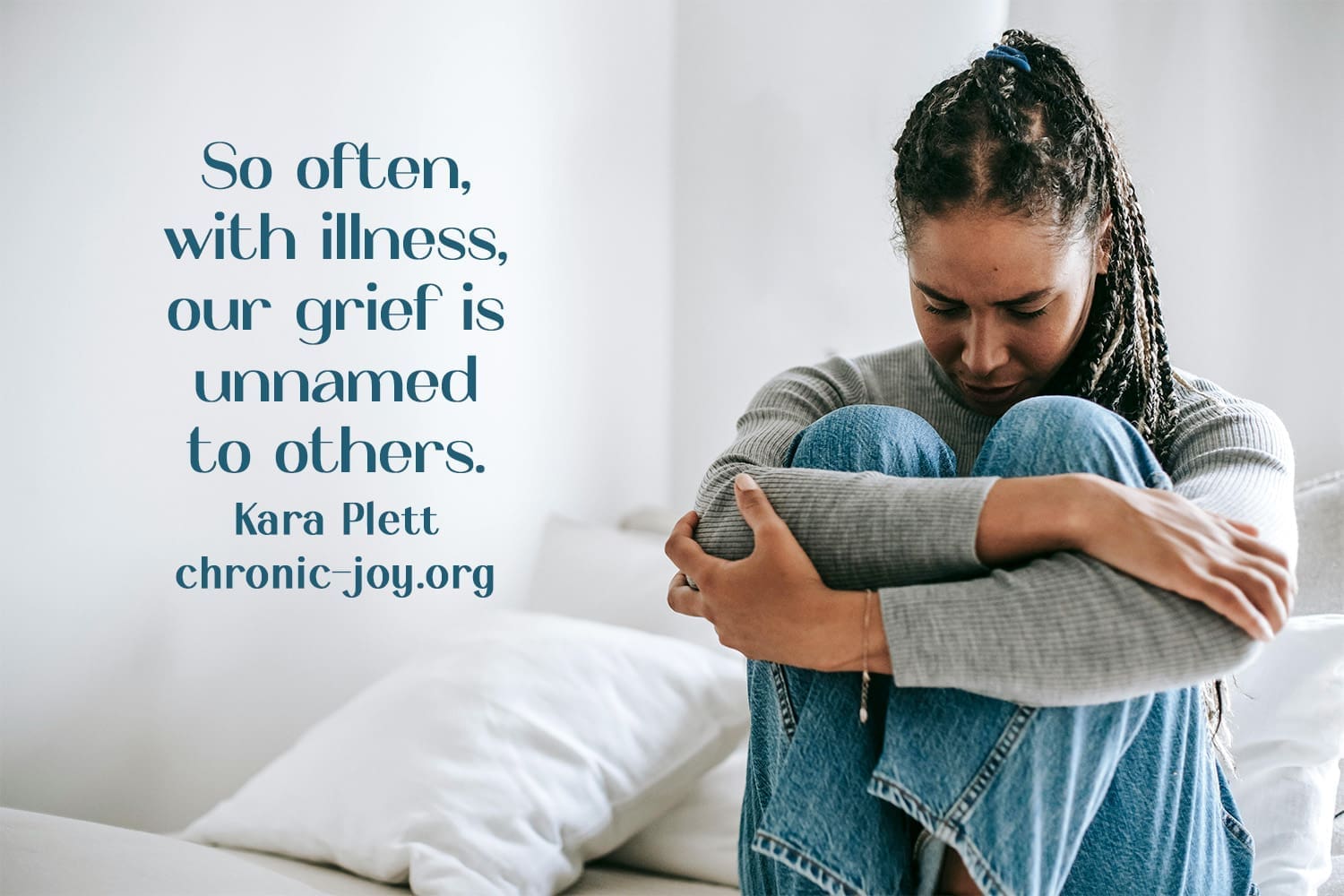
So often, with illness, our grief is unnamed to others. (Kara Plett)
EXPERIENCES WITH GRIEF
I was introduced to grief at the age of 9 when my ten-year-old brother passed away from a brain tumor. I remember watching my friends playing on the church lawn after the funeral, wondering why they felt like playing. I sure didn’t.
More experiences with grief were to come. Sudden deaths of those too young, the “natural” passing of elderly loved ones, the sorrow of broken relationships, or the sadness of what would never be (like not having children). I’m sure many things come to mind for you as well.
Then came a new learning curve – chronic illness. As the doctor shared my diagnosis, he said it would be natural to experience grief. I realized how true this was in the following days and was thankful for his advice. His words permitted me to name what I soon felt: grief.
THE CASCADE OF GRIEF
People talk about a cascade of grief. This has been true for me with chronic illness. Cascading from the initial diagnosis were so many other griefs. Having to stop teaching cascaded into grief about my identity. This poured into grief that my body was no longer able to keep my pre-illness pace of life. This flowed into grieving ministry losses, changes in friendships, less independence, and the loss of hopes and dreams for the future.
Chronic Illness is the gift that keeps on giving…chances to grieve. It seems you work through one area of loss, and in no time, there is something else to say goodbye to. Grieving is a constant part of the chronic illness journey.
Just today, I was talking with my dad, whose kidney failure and daily dialysis have drastically changed his life. As my husband repaired things around my parents’ house, my dad told me, “This is what I find hard—I can’t do any of this anymore.” He was expressing grief without naming it as such.
This is so often the case with our illnesses. Our grief is unnamed to others. Like my experience as a child at my brother’s funeral, the depth of the loss someone faces (as an illness takes bits of life away, for example) cannot be seen or often understood by others. Feeling unseen and misunderstood can add to the grief ...
…but God sees and understands.
You have kept count of my tossings; put my tears in your bottle. Are they not in your book? (Psalm 56:8)
ONE STEP FORWARD
I am not a counselor, but like many of you, I know there are stages to grief: denial, anger, bargaining (looking for hope), depression, and acceptance (leading to hope). The order and length of these are different for each of us. I hope to share some of my experiences so that you feel less alone in your times of grief (which are sure to come). Maybe there will be some way you can take one step forward in your process.
- Some of my initial grief (when I had to stop teaching) was wrapped up in a loss of my identity. It helped me to pick up my pen to journal and express my honest feelings to God. I looked up passages in the Bible to remind me of who God says I am. I wrote these down and put them in places I would readily see them. I’m going to admit that identity continues to be an area where grief can hit me again and again (It's easy to get stuck in anger or depression, and it can be so hard to take a step forward when we feel this way.), but each time, I more easily remember what He has taught me.
- While grieving the future, I made a Reverse Bucket List (a list of things I have already been able to do in my life). It ultimately led me to a place of gratitude. When grief left me feeling like I had little to be thankful for, I began writing down three gifts God gave me each day (simple things like the warm cup of tea in my hand or the sun shining outside).
- When I grieved my purpose, I spent time with God recalling the little things I could still do (texting a friend, praying for others), and He assured me that the small things I can do now are as beautiful to Him as anything I did before. Focusing on the needs of others and spending more time in prayer puts perspective in my life.
- When a new medication didn’t work or yet another diagnosis was given, I felt alone, but as I lamented to God, I soon realized He was right there listening to me cry out. Listening to my favorite worship music and reading encouraging scriptures gradually moved me forward in peace and assurance.
GOD IS WAITING RIGHT THERE
The common thread among all these is that God was there, ready to grieve with me, but I needed to take a step toward Him. He always met me right there, and He still does, because (to be honest) the grieving continues, sometimes with something new, but more often with something I have already grieved, but a new situation brings it to light again. God is there to work it through with me again, and each time, maybe the process is a little faster or easier because I remember His earlier faithfulness.
I pray that we all keep moving that one step closer to the one who wants to grieve with us right where we are today.
PRAYER
Dear Father, our hearts are heavy as we think about the losses brought on by our chronic illnesses. Sometimes, it’s so hard to take a step forward, a step toward You. No matter how it looks, help us to do this, and trust that You will be right there to meet us with compassion and understanding. In Jesus’ name, amen.
QUESTIONS FOR REFLECTION
- Take time to write down your own Cascade of Grief. Allow yourself to recognize each loss.
- Think of a time when God has met you in your grief. What did this look like?
- What possible “steps forward” could you take today?
INVITATION
Chronic Joy has many tools to support us on our grief journeys. Click on Coping with Grief or on any of the links in the devotional for more ways to take one step forward today.


Kara Plett
Ministry Assistant
Kara and her husband Conrad live in Calgary, Canada, where she taught for 28 years. She loves the Word of God and encourages others through her devotional writing. Kara felt led to write a book of devotionals (Searching for Sea Glass) when her journey with chronic illnesses pressed her more deeply into God’s arms of love. She prays that her journey and refinement will encourage your walk with God.
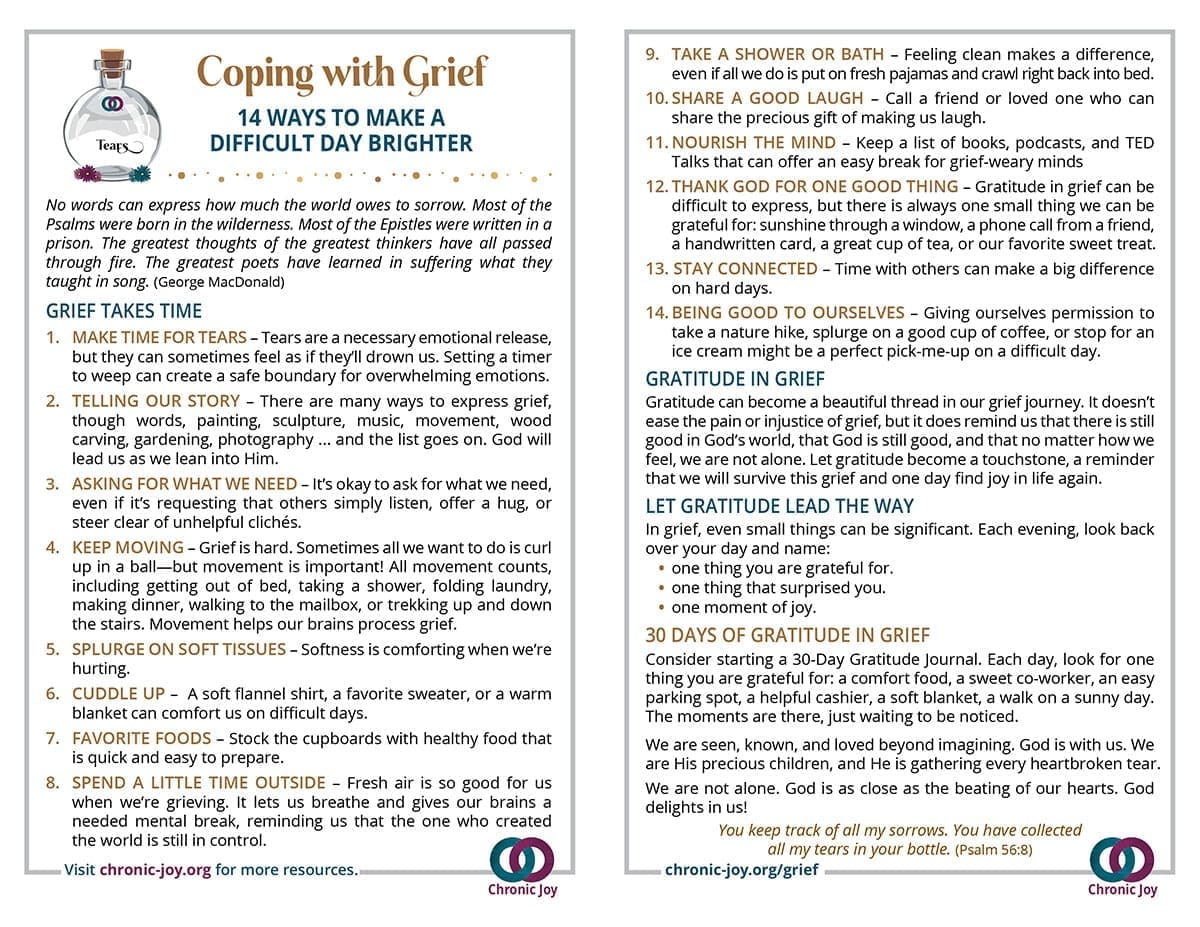
Coping with Grief
14 Ways to Make a Difficult Day Brighter • Grief takes time, but God is with us. He loves us beyond imagining, and He is gathering every heartbroken tear. Gratitude can become a beautiful thread in our grief journey. It doesn’t ease the pain or injustice of grief, but it does remind us that there is still good in God’s world, that God is still good, and that no matter how we feel, we are not alone.
Kara, thank you for writing this. It breathes encouragement as well as practical help. Though I am sorry for all you are enduring, I am thankful for that which God is pouring out of you even in the midst of your hardship. Thank you for using your gift to bless many of us in need of such encouragement.
May you be blest back two-fold and more!!
Melody ~
Thank you, Melody. May you sense His encouragement today.
Thank you so much Kara. I love the idea of the reverse bucket list.God bless you! I always enjoy your articles so much!
Thank you Cindy – may you know His peace today.