
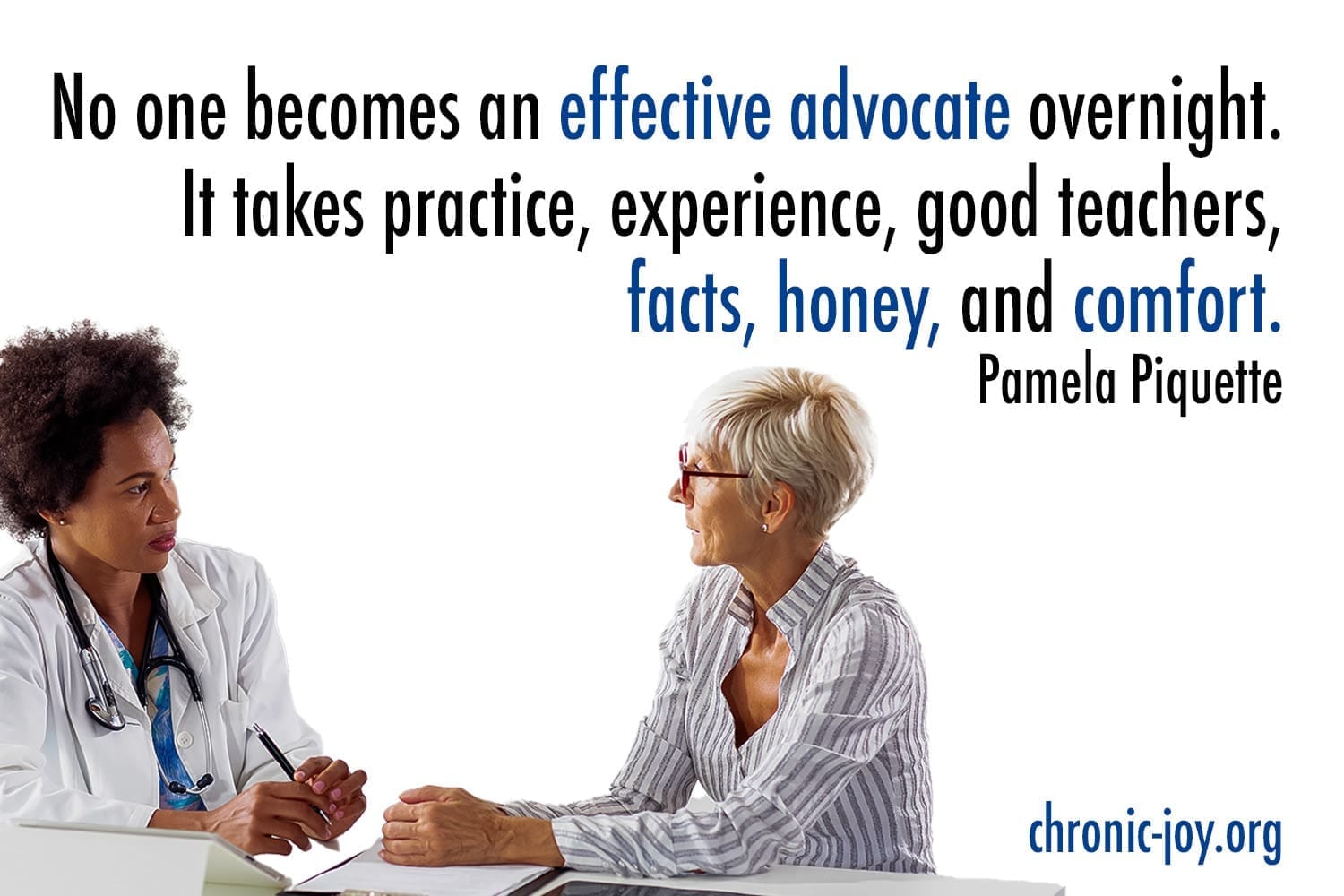
No one becomes an effective advocate overnight. It takes practice, experience, good teachers, facts, honey, and comfort. (Pamela Piquette)
A MOTHER'S EXPERIENCE
Some time ago, a young mother expressed deep disappointment to me that it would be four months before she could see a new chronic illness specialist. Waiting so long when feeling so bad is challenging and frustrating. I suggested she use that time to keep a facts journal:
- a simple grid,
- detailing dates, symptoms, medication, or supplements used to help with symptoms,
- including very brief notes.
- Her doctor could quickly scan such a journal to get a clear picture of how she was doing.
In the months of waiting that followed, her confidence grew as she learned a powerful way to tell her medical story through facts, data, and patterns. At her long-awaited appointment, she was prepared to ask good questions, which aided in developing a treatment plan.
A MOTHER'S KNOWLEDGE
A few years later, her small children began experiencing more-frequent-than-usual illness. When her littlest developed pneumonia, some symptoms improved after several days on antibiotics, but something else was wrong. She messaged the pediatrician, spoke with nurses, and took her little one in for a follow-up appointment, during which they advised no new action was needed.
We spoke a few times throughout that week. At one point, she asked, “Am I overreacting?” I replied, “It doesn’t matter what I think. What matters is what you think.” I gave her a moment to think, then quietly added, “I don’t think you’re overreacting.”
I heard a shift in her voice and felt a strengthening of her spirit as, with confidence, she said, “I know what I’m going to do. I’m going to message the doctor once more, then I’m taking my little one to the Children’s Hospital ER.”
A MOTHER'S ADVICE
When I asked her if I could offer some guidance, she said yes. So, I advised: Keep these three words (words I hoped would be helpful as each carried an idea much bigger than the word itself) in mind:
- facts,
- honey,
- comfort.
Facts: Focus on the facts. While the circumstances are stressful, the priority is to be a strong advocate for your child. Feelings complicate our ability to do that.
Honey: The adage You catch more flies with honey than with vinegar serves well in moments of intense stress. Scripture also provides insight into the importance and benefits of honey: Gracious words are a honeycomb, sweet to the soul and healing to the bones. (Proverbs 16:24)
Comfort: One of our greatest gifts and responsibilities as parents is comforting our children (especially in a medical setting). Often, we feel drawn to assist the medical professionals. Instead, focus on comforting your little one. Do what is meaningful: hold their hand, rub their back or feet, sing a song, or tell a story. As a helpful guide, envision yourself curling up in the lap of God.
Because of the mother’s advocacy, her little was admitted to the hospital with a very serious condition a few hours later.
AN EFFECTIVE ADVOCATE
No one becomes an effective advocate overnight. Practice, experience, and good teachers have helped me become an effective advocate. My kids had a great pediatrician who taught me how to navigate a range of illnesses while helping me recognize patterns and facts. As my chronic conditions became constant companions, I had both hard experiences and challenging doctors who taught me new lessons (like keeping a log of symptoms), which helped me advocate for myself.
This hard-learned advice on advocacy has served me well. I recently needed an infusion, but the nurse recommended at-home medication. While I was frustrated by her message, I knew I needed to advocate for myself, so I called to ask her to reconsider (honey) and presented my facts: that while medication may work, historically it has not. I asked her to reconsider—she relented.
When I called to schedule my appointment, I neglected to request warm saline (comfort). The next day, as the nurse started gathering medication for my infusion, I acknowledged that I had forgotten to request warm saline, but (advocating for myself) asked if getting it was an option. Added to the other comforts I had brought (a preheated rice pillow, my electric throw blanket, and my husband (the best comfort of all) sitting quietly nearby after he’d tucked me under that blanket), warm saline would greatly ease my discomfort.
Perhaps the best piece of advice I have learned about advocating is to be gracious not only to others but also to yourself. Gracious words are a honeycomb, sweet to the soul and healing to the bones.
PRAYER
Gracious Father, too often we allow our feelings to lead. When life is hard, help us to lean into You, to listen to Your still, small voice that guides us to truth, and to receive Your comfort. Help us to be kind to ourselves and one another in all that we say and do. All of this is too hard on our own; we desperately need You. In the powerful name of Jesus, amen.
QUESTIONS FOR REFLECTION
- If you were offering advice on advocating to someone else, what would you say? Are there unique words that come to mind?
- As you learned to advocate for yourself, has your thinking shifted? Are there helpful words that come to mind that can serve as guideposts?
- As you anticipate your next doctor’s appointment, can you devise a method to tell your medical story in a new way? Chronic Joy offers free printable guides (including Telling Your Medical Story and a Medical Story Log Sheet), which are sure to prompt new ideas and make talking with your doctor more productive.


Pamela Piquette
Executive Director and Co-Founder of Chronic Joy®
Pamela, a leader and a visionary following God's call to inspire those affected by chronic illness, mental illness, and chronic pain, believes that every precious life impacted by illness is both vital and purposed.
Pamela is a wife of more than 35 years, the mom of three married children, and a grandma of six. She is diagnosed with chronic migraines and other chronic conditions. She enjoys baking sourdough bread and chocolate chip cookies, drinking hot tea, being outdoors, and reading (almost always more than one book at a time).
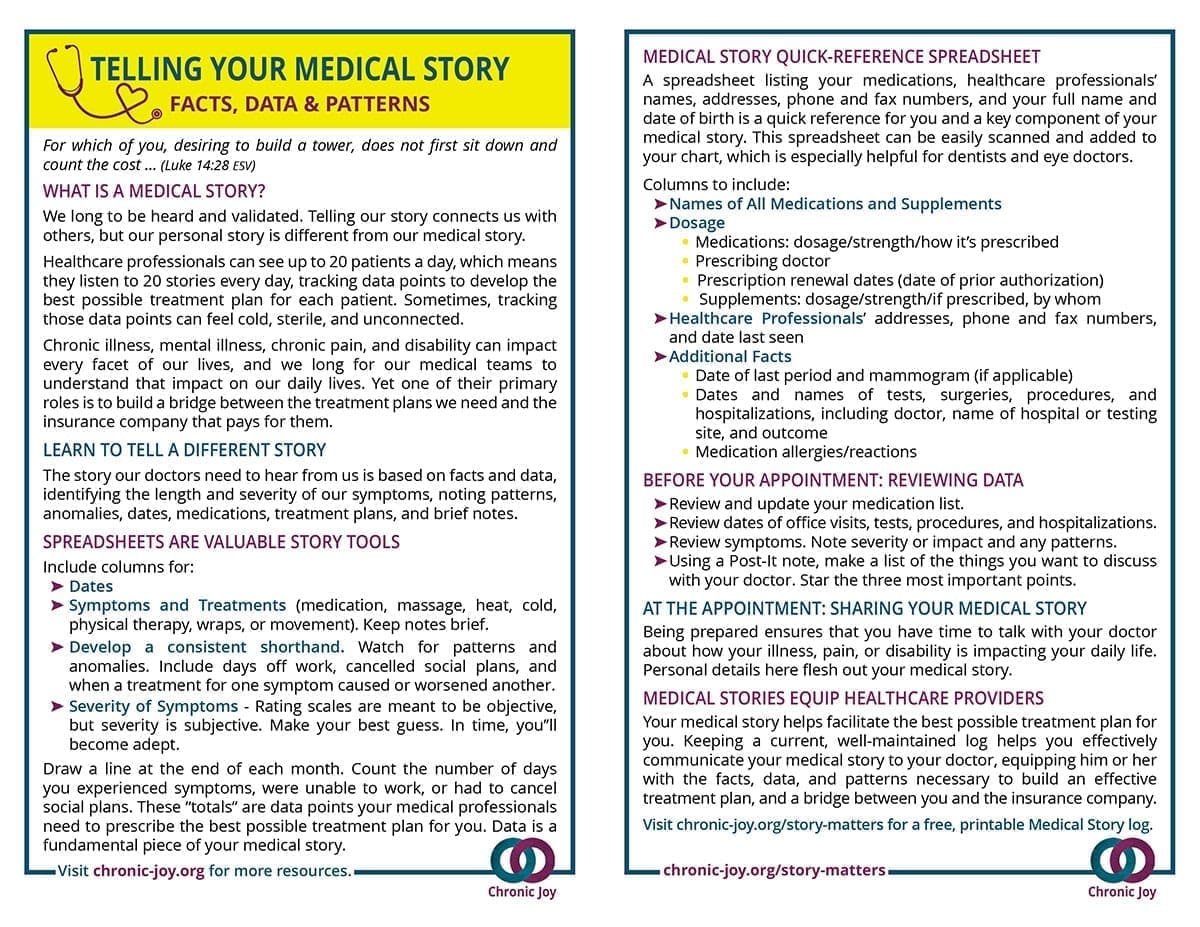
Telling Your Medical Story
What is a Medical Story? For our healthcare teams to build the best possible treatment plans for us, we need to learn to keep well-maintained logs of symptoms (and their severity), medications, treatments, dates, and brief notes. Keep track with our Medical Story Log.
Recent Comments